

Before the Norman conquest in 1066, Bramall was held as two separate manors, owned by two Saxon freemen – Brun and Hacun. A few years later, William the Conqueror subdued the North West of England, and he gave both parts of the manor land to Hamon de Masci, the first Baron of Dunham Massey, who was one of his followers. The Bramall land was probably a waste, having been devastated during William the Conqueror’s harsh subjugation of the North West of England. During the next 800 years three families owned the estate: The Massey’s, the de Bromale’s and the Davenport’s.
The manor passed from the second Baron of Dunham Massey to one of his kinsmen, who took his name from the land which he acquired and became Mathew de Bromale. It was customary at that time for lords to take on the local name.
The Bromales remained as Lords of the Manor until the late 14th century, when Geoffrey de Bromale died. After his death, the estate passed to his daughter Alice, who was married to John de Davenport. The descendants of John and Alice Davenport lived at Bramall Hall for 500 years.
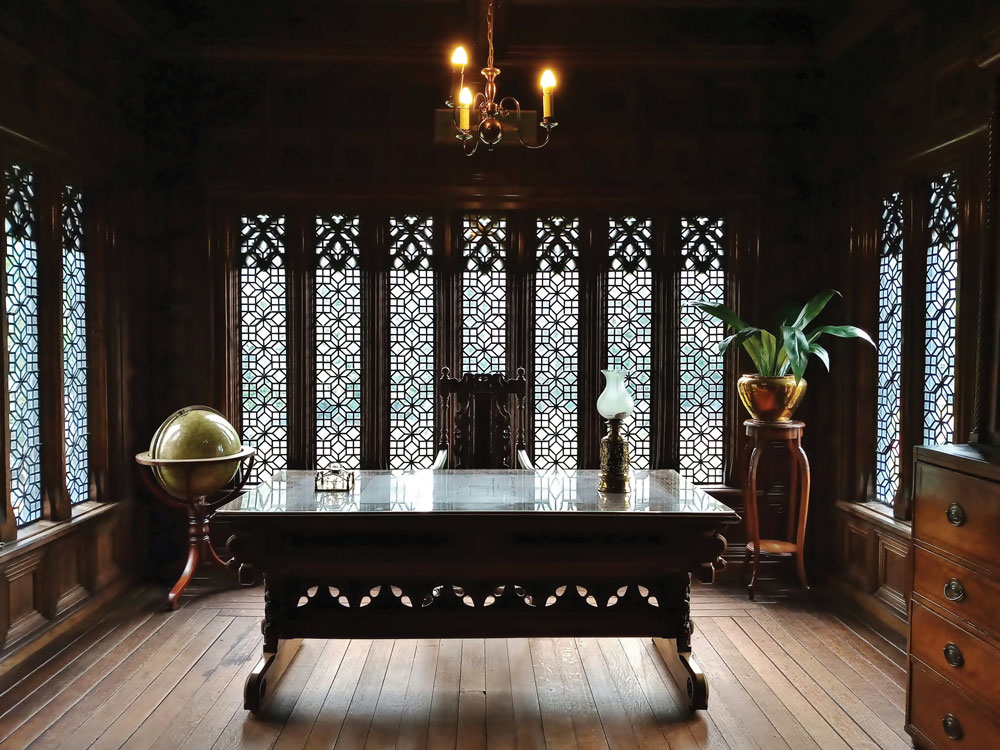
The Manor house has many interesting features. The Great Hall was the centre of the household during the middle ages where everyone would gather. The Banqueting Room was built in the early 15th century and served as a billiard room by the 19th century. There is also a Chapel and
a Ballroom.
Bramhall Park
The Park provides a beautiful landscape setting for the Hall. The house is set in 70 acres of parkland, which have been landscaped in the style of Capability Brown. The park features two lakes, woodland walks and gardens. Today, few clues to the park’s ancient history remain. In Saxon times, it formed part of the land held as two manors.
The Origins of the Name
The area around Bramall Hall is known as Bramhall, and there has been much controversy over the correct spelling of the name of the Hall, which is spelt without the ‘h’. In the Doomsday Book, the manor of Bramall is called Bramale, a name derived from the Old English words ‘brom’, meaning broom, and ‘halh’, meaning a secret place, generally near water. The current name was chosen as the spelling closest to this Doomsday version. It was favoured both by the Hall’s Victorian owner. Charles Nevill, and by Hazel Grove and Bramhall Urban District Council who took over the Hall in 1935.
Bramhall Family History
About a hundred years after the Domesday Survey, the lands were held by a family which bore the local name – Bromale. Bramhall was probably held by six generations of the Bromale family covering a period of about 200 years, from A.D.1180 to 1380. The last of the Bromales, Geoffrey de Bromale, had a daughter, Alice, who married John de Davenport, of Wheltrough, and so carried the Bramhall estate into that family.
The various families of Davenport may be traced back to Ormus de Davenport, who lived in the time of William the Conqueror. One of the offices held by the Davenports was that of Grand Sergeant of Macclesfield Forest. The powers of this official were very great; he had the power of life and death and it is probable that the felon’s head, with a halter round the neck was adopted as the Davenport Crest as illustrative of these powers.
After holding possession of Bramhall for four and a half centuries, the male line became extinct upon the death of William Davenport in 1829, who left his estate to his daughters, Maria and Ann then living with him in Bramhall Hall.
At that time Bramhall was mainly an agricultural village formed from a collection of hamlets that included Syddal, Pownall Green and Bramhall Green and did not develop into a ‘village’ until after the station was opened in 1845.
Bramhall Village History
The centre of the village was then at Bramhall Green, at the gates of Bramall Hall. Here was situated the only mill in Bramhall run by the Ladybrook, although the last miller left in 1800. The first school in Bramhall was situated at the Green and was opened in 1741 by Warren Davenport. By 1819 it had been converted to cottages.
The pinfold, a blacksmith, a tailor’s shop and an Inn called the ‘Shoulder of Mutton’ were alongside several houses. The village stocks are now kept at Bramall Hall.
In 1845, the Macclesfield branch of the Manchester and Birmingham railway opened, connecting Bramhall on a direct line to Manchester. The effect of this was to move the centre of the village to its present position near the station, about one mile away from Bramhall Green, and to change Bramhall into a more expensive residential area. This caused the population to increase from 1033 in 1801 to 3365 in 1891.
Bramhall has continued to grow rapidly, the population increasing tenfold in 90 years. This was due to large housing estates being built on what had once been farmland to attract people to the area.
By David Wilkinson
Photo by Adam Marikar - unsplash.com