

The name Woodford, or derivatives of Woodford, dates back to the Middle Ages, when 500 square miles of forest covered the area, from Leek to Marple. The name is most likely attributed to the crossing of the River Dean, near the Deanwater Hotel, meaning the place in the Wood to ford the river, or perhaps the ford made of wood. The jury is out on that one, as there will likely be contributions in future issues to further the debate.
In the 19th century, employment was in agriculture, the milling of printed calico, and the cottage industry of silk weaving. The Davenport family fortuitously became landowners in the 14th century, and in the mid-19th century, the Bromley-Davenports built Christchurch and the Primary School, before acquiring Capesthorne Hall already owned by the Davenport family.
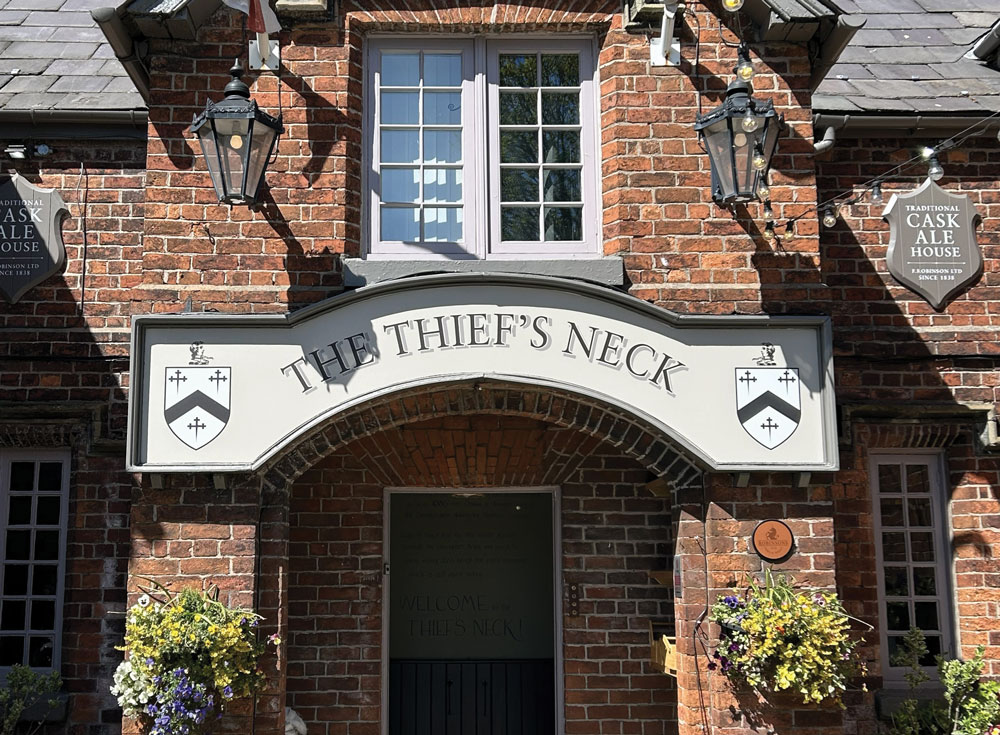
The Davenport Arms, known locally as the ‘Thief’s Neck’, carries the Davenport Coat of Arms, which used to include an image of a thief with a rope around his neck. As hereditary foresters of the King, the Davenports had the authorised power to put poachers to death without trial.
The growth of Woodford was accelerated by the aviation pioneer Edwin Alliott Verdon Roe. His brother Humphrey, Alliott Roe founded the A.V. Roe Aircraft Co. in 1910, later renamed Avro Aircraft.
Woodford Aerodrome was created from farmland by AV Roe during 1924. In the 1930s several new buildings were added. Planes manufactured there including Avro Ansons, Lancasters, Vulcan nuclear bombers, civil airliners and the Nimrod maritime patrol aircraft.
From 1968 to 2000, an annual air show was held at the Aerodrome, organised by the Royal Air Forces Association, which locally created a humorous catchphrase: “That went right over my head, like Woodford Airshow.” In 1989, 3,000 people were employed on the site, but in 2012, BAE Systems closed the site, resulting in the loss of the remaining 630 jobs. The site made way for houses and now includes the Avro Heritage Museum, with an excellent display featuring a static Vulcan Bomber (the aircraft used in the Falklands War bombings).
By David Wilkinson